
![[personal profile]](https://www.dreamwidth.org/img/silk/identity/user.png)


(no subject)
I was in Clarkston this weekend, doing this thing, when I noticed something really cool about the huuj, ginormous bluffs that tower over the city.

Sierpinski triangles! Roughly. It doesn't come through on the image as well as I'd like. (It's a link to a much larger version, but even that one doesn't really capture it. And half of you won't be able to connect to cyphertext.net anyway.) But yay, found math!
Edit:
I was bored, so I highlighted the ridge lines. (No, I don't claim I was particularly impartial in the process. The point here is to share an experience, not to prove a theory.)

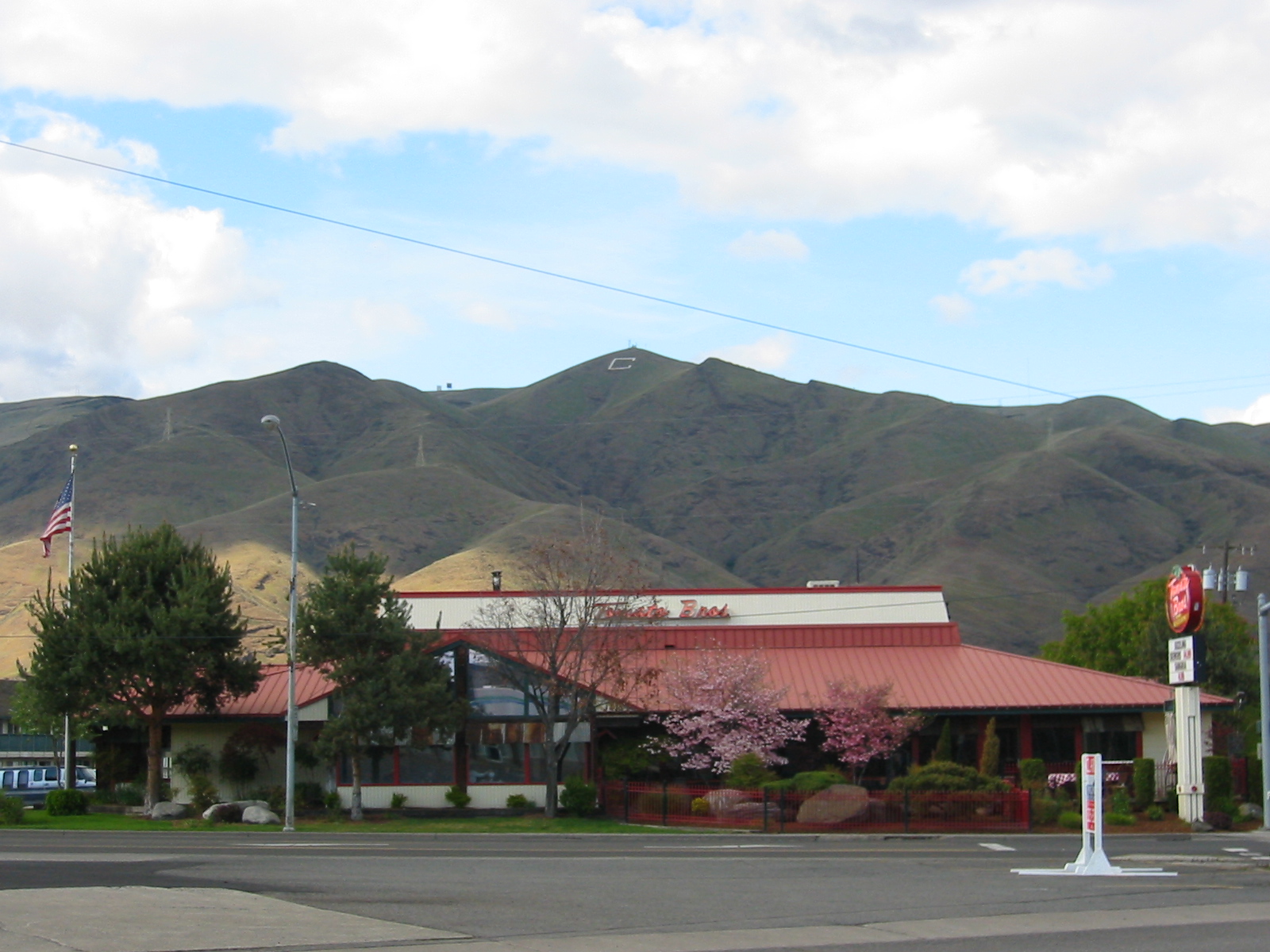
Sierpinski triangles! Roughly. It doesn't come through on the image as well as I'd like. (It's a link to a much larger version, but even that one doesn't really capture it. And half of you won't be able to connect to cyphertext.net anyway.) But yay, found math!
Edit:
I was bored, so I highlighted the ridge lines. (No, I don't claim I was particularly impartial in the process. The point here is to share an experience, not to prove a theory.)
no subject
no subject
Note that some rules generate straight-up Sierpinski triangles, while others introduce more apparent chaos, much like these hills.
Neat!
no subject
Somewhere I have a shell like this one (http://users.frii.com/davejen/shell.jpg), but with a denser pattern more like this (http://psoup.math.wisc.edu/mcell/rules/1dto_marvel.gif). Pretty neat to see nature's laziness at work.
no subject
no subject
no subject
It's a very basic fractal. (Also known as a Sierpinski gasket.) Take an equilateral triangle. Divide into 4 smaller equilateral triangles. Remove the center one. Recursively apply to the remaining 3. It quickly approaches something with an infinite border but zero surface area. A Menger sponge (http://mathworld.wolfram.com/mimg1726.gif) is a related, three-dimensional concept.
The same shape is created if you take Pascal's triangle (http://www.alunw.freeuk.com/pascal.html) and separate it into even and odd components.
They can also be generated through cellular automata, which is what I was thinking of here. Like Conway's Life, but one-dimensional. If a cell has one or two neighbors, turn it on, else turn it off. If you start with a single cell and plot the result into the second dimension, you get a Sierpinski triangle. If you start with random cells turned on, you end up with something like the seashell I linked to above.
no subject
I can see my house from here!
You took that photo from the parking lot of my old workplace.
Past the initial shiver of scrolling down past a picture of familiar hills next to the icon of a Seattle identity (which is pretty big cognitive dissonance in and of itself), the utter certainty of location was disconcerting.
Re: I can see my house from here!