![[personal profile]](https://www.dreamwidth.org/img/silk/identity/user.png)
![[identity profile]](https://www.dreamwidth.org/img/silk/identity/openid.png)
Two days ago I experienced freefall. I should have made an update already but this is the first time since the flight that I've been not-asleep and not-busy.
3.5 years ago I was having dinner with![[livejournal.com profile]](https://www.dreamwidth.org/img/external/lj-userinfo.gif) xiadyn, xmurf and corivax and I commented that it would be really, really cool to fly on the vomit comet. corivax mentioned that there was a NASA research opportunity for undergrads to fly experiments. So what could we build to get us on there? A robot sounded like fun, sure. And after a lot of talk and 1.5 years of work, the space robot flew this week. Technologically it was a disaster. Very little worked, none of it anything interesting. But lots of the experiements failed, so it doesn't look too bad for us. There is no reason to think we couldn't fly it again next year.
xiadyn, xmurf and corivax and I commented that it would be really, really cool to fly on the vomit comet. corivax mentioned that there was a NASA research opportunity for undergrads to fly experiments. So what could we build to get us on there? A robot sounded like fun, sure. And after a lot of talk and 1.5 years of work, the space robot flew this week. Technologically it was a disaster. Very little worked, none of it anything interesting. But lots of the experiements failed, so it doesn't look too bad for us. There is no reason to think we couldn't fly it again next year.
I'm not sure how to describe the experience. It is already becoming severly unreal to me, just too weird to remember normally. The vomit comet (or 'weightless wonder' as NASA insists we call it) flies 10 parabolas in a row, creating a nice, constant sinusoidal wave. This means you experience ~30 seconds of freefall followed by a ~30 seconds of 1.8g pullout, with short periods of somewhat normal gravity in between. It isn't the freefall that gives you motion sickness, it is the back-and-forth between freefall and 1.8gs. After 10 parabolas it turns around for the next set, giving you ~5 minutes of 1g. They normally fly 3 sets, plus parabolas at lunar and martian gravity. The freefall isn't very good, being dependant on a human pilot flying a very narrow path through sometimes turbulent air. Things tend to move back and up, and occasionally there are sharp jerks where everything falls in a random direction for a split second.
Freefall by itself was wonderful. I don't think I can explain how amazing it is to see something floating in front of you. Despite being in a loud plane surrounded by people, it was very peaceful. I was expecting it to feel a lot like falling, like the giddy tenth of a second when you jump as an elevator stops. It wasn't like that at all. The only disorienting feeling was the visual perception as it started that down was twisting around to be directly in front of you. That passed. It just felt very... pure. Floating there, not pressed against anything, needing only the slightest touch to move. It took until almost the end of the flight to get used to that last part. For the first half, whenever I tried to move I ended up on the (wall that would soon become the) ceiling, flailing a bit. Gravity returns fairly suddenly so you really don't want to be floating over an experiments or somebody else when it happens. When the flight crew yells 'feet down!' you learn to take it seriously. It took time to get used to very small, careful movements. Hard not to flail a bit when your legs aren't in contact with anything. Arms are far more useful in freefall. At the end I was getting a lot more confident and was able to navigate without too much difficulty.
Along with the hypobaric chamber training, NASA provides a lot of advice about motion sickness. In short: stay cool, don't twist your head around during the 1.8g section, and try to stay 'vertical'. Around parabola 25 I started to feel not very well. It had been building for a while, but I had been too busy debugging the robot to notice. I got a barf bag ready and tried not to move my head at all. The flight surgeon came over to deal with the potential mess. I barely swallowed back a heave, and realized that I was actually quite hot. So I unzipped my flight suit and took it half off. I felt better immediately. So while I'm not part of the 1/3 of humanity that can do this without any problems at all, neither am I part of the 1/3 of humanity that become violently, incapacitatingly ill. Good to know.
NASA is very serious about FOD (foreign object damage) prevention. They are also very serious about strapping everything down before the flight. While I intellectually understood these concerns before, freefall gave me a very personal appreciation of their importance. For a few hours after the flight it was slightly unnerving to see things just sitting on tables, waiting to float away. Things floating that aren't supposed to float are dangerous. If they're of any size they can fall on you when gravity returns. If they small they can get into your eyes or be inhaled. Walking out of the hanger to the car afterwords was also disconcerting. Outside is kind of scary after freefall. A whole lot of room to float off into, with nothing to hold onto. A long way to drop when gravity returns.
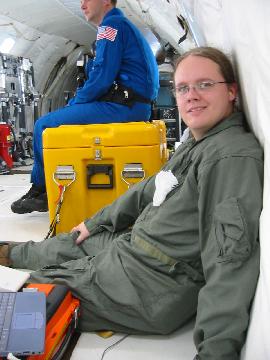
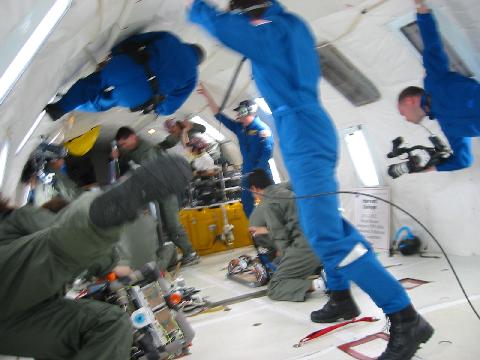
The robot was a complete failure, but at least I got to compile code in freefall. In the rush that morning we forgot the camcorder, so I don't have any video of myself yet. In a few weeks we'll get the footage that the NASA videographers and photographers were taking. I did get some pictures with my digital camera, but they aren't very good. Here I am after we were set up, waiting for the parabolas to begin. This picture can give you an idea of what a parabola is like. Pretty chaotic. And here is the space robot floating, tended by the very competant NASA person Troy withdymaxion floating in front of them.
I want the space robot to work. I want to hear the thrusters firing and see it twisting in response. I want to go back.
Constant acceleration is boring.
3.5 years ago I was having dinner with
xiadyn, xmurf and corivax and I commented that it would be really, really cool to fly on the vomit comet. corivax mentioned that there was a NASA research opportunity for undergrads to fly experiments. So what could we build to get us on there? A robot sounded like fun, sure. And after a lot of talk and 1.5 years of work, the space robot flew this week. Technologically it was a disaster. Very little worked, none of it anything interesting. But lots of the experiements failed, so it doesn't look too bad for us. There is no reason to think we couldn't fly it again next year.I'm not sure how to describe the experience. It is already becoming severly unreal to me, just too weird to remember normally. The vomit comet (or 'weightless wonder' as NASA insists we call it) flies 10 parabolas in a row, creating a nice, constant sinusoidal wave. This means you experience ~30 seconds of freefall followed by a ~30 seconds of 1.8g pullout, with short periods of somewhat normal gravity in between. It isn't the freefall that gives you motion sickness, it is the back-and-forth between freefall and 1.8gs. After 10 parabolas it turns around for the next set, giving you ~5 minutes of 1g. They normally fly 3 sets, plus parabolas at lunar and martian gravity. The freefall isn't very good, being dependant on a human pilot flying a very narrow path through sometimes turbulent air. Things tend to move back and up, and occasionally there are sharp jerks where everything falls in a random direction for a split second.
Freefall by itself was wonderful. I don't think I can explain how amazing it is to see something floating in front of you. Despite being in a loud plane surrounded by people, it was very peaceful. I was expecting it to feel a lot like falling, like the giddy tenth of a second when you jump as an elevator stops. It wasn't like that at all. The only disorienting feeling was the visual perception as it started that down was twisting around to be directly in front of you. That passed. It just felt very... pure. Floating there, not pressed against anything, needing only the slightest touch to move. It took until almost the end of the flight to get used to that last part. For the first half, whenever I tried to move I ended up on the (wall that would soon become the) ceiling, flailing a bit. Gravity returns fairly suddenly so you really don't want to be floating over an experiments or somebody else when it happens. When the flight crew yells 'feet down!' you learn to take it seriously. It took time to get used to very small, careful movements. Hard not to flail a bit when your legs aren't in contact with anything. Arms are far more useful in freefall. At the end I was getting a lot more confident and was able to navigate without too much difficulty.
Along with the hypobaric chamber training, NASA provides a lot of advice about motion sickness. In short: stay cool, don't twist your head around during the 1.8g section, and try to stay 'vertical'. Around parabola 25 I started to feel not very well. It had been building for a while, but I had been too busy debugging the robot to notice. I got a barf bag ready and tried not to move my head at all. The flight surgeon came over to deal with the potential mess. I barely swallowed back a heave, and realized that I was actually quite hot. So I unzipped my flight suit and took it half off. I felt better immediately. So while I'm not part of the 1/3 of humanity that can do this without any problems at all, neither am I part of the 1/3 of humanity that become violently, incapacitatingly ill. Good to know.
NASA is very serious about FOD (foreign object damage) prevention. They are also very serious about strapping everything down before the flight. While I intellectually understood these concerns before, freefall gave me a very personal appreciation of their importance. For a few hours after the flight it was slightly unnerving to see things just sitting on tables, waiting to float away. Things floating that aren't supposed to float are dangerous. If they're of any size they can fall on you when gravity returns. If they small they can get into your eyes or be inhaled. Walking out of the hanger to the car afterwords was also disconcerting. Outside is kind of scary after freefall. A whole lot of room to float off into, with nothing to hold onto. A long way to drop when gravity returns.
The robot was a complete failure, but at least I got to compile code in freefall. In the rush that morning we forgot the camcorder, so I don't have any video of myself yet. In a few weeks we'll get the footage that the NASA videographers and photographers were taking. I did get some pictures with my digital camera, but they aren't very good. Here I am after we were set up, waiting for the parabolas to begin. This picture can give you an idea of what a parabola is like. Pretty chaotic. And here is the space robot floating, tended by the very competant NASA person Troy with
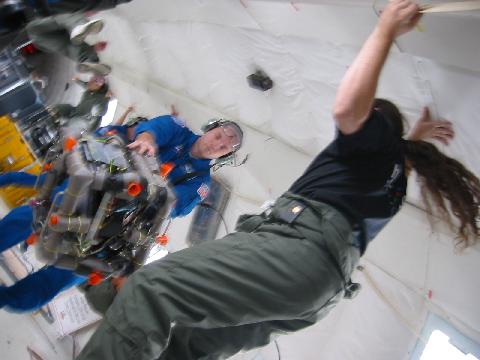 dymaxion floating in front of them.
I want the space robot to work. I want to hear the thrusters firing and see it twisting in response. I want to go back.
Constant acceleration is boring.
Wow
Good luck with fixing up the 'bot.