![[personal profile]](https://www.dreamwidth.org/img/silk/identity/user.png)
![[identity profile]](https://www.dreamwidth.org/img/silk/identity/openid.png)
Stolen from ![[livejournal.com profile]](https://www.dreamwidth.org/img/external/lj-userinfo.gif) basal_surge. It was such a delightfully geeky meme that I had to do it.
basal_surge. It was such a delightfully geeky meme that I had to do it.
Things I have seen or done
1. See an erupting volcano I've seen some dust kicked up from landslides in the Mt. St. Helens caldera when it was thinking about erupting again... but that really doesn't count
2. See a glacier
3. See an active geyser such as those in Yellowstone, New Zealand or the type locality of Iceland
4. Visit the Cretaceous/Tertiary (KT) Boundary. Possible locations include Gubbio, Italy, Stevns Klint, Denmark, the Red Deer River Valley near Drumheller, Alberta.
5. Observe (from a safe distance) a river whose discharge is above bankful stage Just as glad I've never been close to that, after seeing the New Orleans damage
6. Explore a limestone cave. When I did a report on tectonic drift in 3rd grade, we went and talked to a geologist at EWU. He invited me down to a small cave in the area, but unfortunately when we went he wasn't there so we just got the standard tour.
7. Tour an open pit mine, such as those in Butte, Montana, Bingham Canyon, Utah, Summitville, Colorado, Globe or Morenci, Arizona, or Chuquicamata, Chile. We were in Butte when I was... I dunno, 12ish? There are a lot of neat tours and museums there, if you like massive Victorian mining history
8. Explore a subsurface mine. At some point I went on a tour of one of the old silver mines up around Kellog, Idaho
9. See an ophiolite, such as the ophiolite complex in Oman or the Troodos complex on the Island Cyprus.
10. An anorthosite complex, such as those in Labrador, the Adirondacks, and Niger.
11. A slot canyon. Many of these amazing canyons are less than 3 feet wide and over 100 feet deep. They reside on the Colorado Plateau. Among the best are Antelope Canyon, Brimstone Canyon, Spooky Gulch and the Round Valley Draw.
12. Varves, whether you see the type section in Sweden or examples elsewhere.
13. An exfoliation dome, such as those in the Sierra Nevada.
14. A layered igneous intrusion, such as the Stillwater complex in Montana or the Skaergaard Complex in Eastern Greenland.
15. Coastlines along the leading and trailing edge of a tectonic plate (check out The Dynamic Earth - The Story of Plate Tectonics - an excellent website).
16. A ginkgo tree, which is the lone survivor of an ancient group of softwoods that covered much of the Northern Hemisphere in the Mesozoic.
17. Living and fossilized stromatolites (Glacier National Park is a great place to see fossil stromatolites, while Shark Bay in Australia is the place to see living ones)
18. A field of glacial erratics
19. A caldera
20. A sand dune more than 200 feet high
21. A fjord I live not too far from the southernmost fjord in the northern hemisphere! Or so I've been told, anyway
22. A recently formed fault scarp
23. A megabreccia
24. An actively accreting river delta Paddled through one, in fact.
25. A natural bridge
26. A large sinkhole
27. A glacial outwash plain
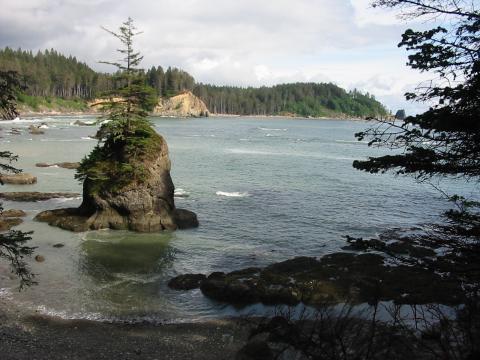
28. A sea stack I do so love this part of the world
29. A house-sized glacial erratic These are really common around Spokane
30. An underground lake or river
31. The continental divide Just the one, but I've been across it in several different places
32. Fluorescent and phosphorescent minerals
33. Petrified trees
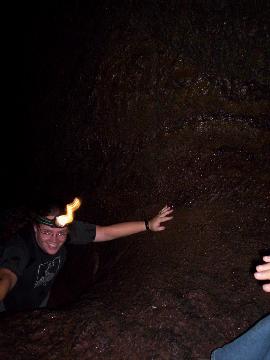
34. Lava tubes We hiked through the longest one in this hemisphere, on the side of Mt. St. Helens.
35. The Grand Canyon. All the way down. And back. No, I haven't gone down.
36. Meteor Crater, Arizona, also known as the Barringer Crater, to see an impact crater on a scale that is comprehensible (and it is quite BIG) I'm an idiot, never mind.
37. The Great Barrier Reef, northeastern Australia, to see the largest coral reef in the world. I really need to do this, while we still have coral reefs to go see. Coming from this part of the world, the idea of warm, clear sea water and brightly colored sea life is just bizarre.
38. The Bay of Fundy, New Brunswick and Nova Scotia, Canada, to see the highest tides in the world (up to 16m)
39. The Waterpocket Fold, Utah, to see well exposed folds on a massive scale.
40. The Banded Iron Formation, Michigan, to better appreciate the air you breathe.
41. The Snows of Kilimanjaro, Tanzania.
42. Lake Baikal, Siberia, to see the deepest lake in the world (1,620 m) with 20 percent of the Earth’s fresh water.
43. Ayers Rock (known now by the Aboriginal name of Uluru), Australia. This inselberg of nearly vertical Precambrian strata is about 2.5 kilometers long and more than 350 meters high
44. Devil’s Tower, northeastern Wyoming, to see a classic example of columnar jointing
45. The Alps.
46. Telescope Peak, in Death Valley National Park. From this spectacular summit you can look down onto the floor of Death Valley - 11,330 feet below.
47. The Li River, China, to see the fantastic tower karst that appears in much Chinese art
48. The Dalmation Coast of Croatia, to see the original Karst.
49. The Gorge of Bhagirathi, one of the sacred headwaters of the Ganges, in the Indian Himalayas, where the river flows from an ice tunnel beneath the Gangatori Glacier into a deep gorge.
50. The Goosenecks of the San Juan River, Utah, an impressive series of entrenched meanders.
51. Shiprock, New Mexico, to see a large volcanic neck
52. Land’s End, Cornwall, Great Britain, for fractured granites that have feldspar crystals bigger than your fist.
53. Tierra del Fuego, Chile and Argentina, to see the Straights of Magellan and the southernmost tip of South America.
54. Mount St. Helens, Washington, to see the results of recent explosive volcanism.
55. The Giant’s Causeway and the Antrim Plateau, Northern Ireland, to see polygonally fractured basaltic flows. There is plenty of this in central Washington
56. The Great Rift Valley in Africa.
57. The Matterhorn, along the Swiss/Italian border, to see the classic “horn”.
58. The Carolina Bays, along the Carolinian and Georgian coastal plain
59. The Mima Mounds near Olympia, Washington I've never heard of this! I'm going to have to put together an expedition to go check them out
60. Siccar Point, Berwickshire, Scotland, where James Hutton (the “father” of modern geology) observed the classic unconformity
61. The moving rocks of Racetrack Playa in Death Valley
62. Yosemite Valley
63. Landscape Arch (or Delicate Arch) in Utah I'm not sure. We visited Arches National Park, but I don't remember exactly what we saw there
64. The Burgess Shale in British Columbia Again, I should really go
65. The Channeled Scablands of central Washington I grew up with a rather different Great Flood story than most people...
66. Bryce Canyon
67. Grand Prismatic Spring at Yellowstone
68. Monument Valley
69. The San Andreas fault
70. The dinosaur footprints in La Rioja, Spain
71. The volcanic landscapes of the Canary Islands
72. The Pyrennees Mountains
73. The Lime Caves at Karamea on the West Coast of New Zealand
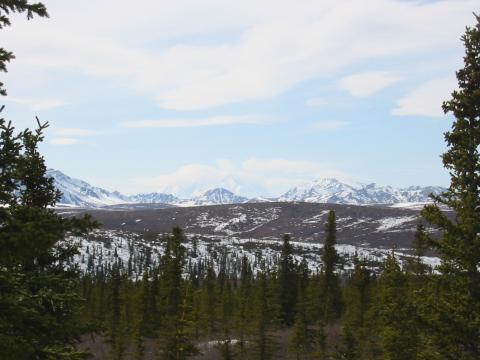
74. Denali (an orogeny in progress) We visited the park right at the beginning of the season, during the week or two you're allowed to drive in yourself. We got even more lucky and were just able to see Denali. Driving along we kept wondering which mountain it was, and would we be able to tell -- there was no question once we saw it. It's the only mountain I've ever seen to outclass Rainier for visual bulk and majesty.
75. A catastrophic mass wasting event
76. The giant crossbeds visible at Zion National Park
77. The black sand beaches in Hawaii (or the green sand-olivine beaches)
78. Barton Springs in Texas
79. Hells Canyon in Idaho I'm not sure. I've rafted some of the Snake, anyway
80. The Black Canyon of the Gunnison in Colorado
81. The Tunguska Impact site in Siberia
82. Feel an earthquake with a magnitude greater than 5.0. Nisqually Quake, 2001. Only earthquake I've ever noticed, oddly enough.
83. Find dinosaur footprints in situ
84. Find a trilobite (or a dinosaur bone or any other fossil) If plant fossils count, anyway
85. Find gold, however small the flake
86. Find a meteorite fragment
87. Experience a volcanic ashfall. Mt. St. Helens, 1980! We got a good inch or so. I don't remember it very well. I do know that I didn't like wearing the filter mask, so my mom drew cat whiskers on it.
88. Experience a sandstorm Does a 8 hour duststorm count? I'm going to say it counts.
89. See a tsunami
90. Witness a total solar eclipse No, dammit.
91. Witness a tornado firsthand
92. Witness a meteor storm, a term used to describe a particularly intense (1000+ per minute) meteor shower
93. View Saturn and its moons through a respectable telescope.
94. See the Aurora borealis, otherwise known as the northern lights. We went through a northern lights hunting phase a couple years ago. One of those weird things that I managed to never see living at 47N all my life, and then it's really easy and common once you start trying. We got lucky and went out during one of the bigger solar storms ever recorded. It was glorious.
95. View a great naked-eye comet, an opportunity which occurs only a few times per century
96. See a lunar eclipse
97. View a distant galaxy through a large telescope
98. Experience a hurricane One of the times I was in DC they were getting a bunch of rain from the tail end of one, but that's as close as I've come
99. See noctilucent clouds
100. See the green flash. Also, dammit, no. I really want to.
I suspect I've seen several of the more generic geological items here, but I wasn't aware of it as such so I don't think it counts.
basal_surge. It was such a delightfully geeky meme that I had to do it.Things I have seen or done
1. See an erupting volcano I've seen some dust kicked up from landslides in the Mt. St. Helens caldera when it was thinking about erupting again... but that really doesn't count
2. See a glacier
3. See an active geyser such as those in Yellowstone, New Zealand or the type locality of Iceland
4. Visit the Cretaceous/Tertiary (KT) Boundary. Possible locations include Gubbio, Italy, Stevns Klint, Denmark, the Red Deer River Valley near Drumheller, Alberta.
5. Observe (from a safe distance) a river whose discharge is above bankful stage Just as glad I've never been close to that, after seeing the New Orleans damage
6. Explore a limestone cave. When I did a report on tectonic drift in 3rd grade, we went and talked to a geologist at EWU. He invited me down to a small cave in the area, but unfortunately when we went he wasn't there so we just got the standard tour.
7. Tour an open pit mine, such as those in Butte, Montana, Bingham Canyon, Utah, Summitville, Colorado, Globe or Morenci, Arizona, or Chuquicamata, Chile. We were in Butte when I was... I dunno, 12ish? There are a lot of neat tours and museums there, if you like massive Victorian mining history
8. Explore a subsurface mine. At some point I went on a tour of one of the old silver mines up around Kellog, Idaho
9. See an ophiolite, such as the ophiolite complex in Oman or the Troodos complex on the Island Cyprus.
10. An anorthosite complex, such as those in Labrador, the Adirondacks, and Niger.
11. A slot canyon. Many of these amazing canyons are less than 3 feet wide and over 100 feet deep. They reside on the Colorado Plateau. Among the best are Antelope Canyon, Brimstone Canyon, Spooky Gulch and the Round Valley Draw.
12. Varves, whether you see the type section in Sweden or examples elsewhere.
13. An exfoliation dome, such as those in the Sierra Nevada.
14. A layered igneous intrusion, such as the Stillwater complex in Montana or the Skaergaard Complex in Eastern Greenland.
15. Coastlines along the leading and trailing edge of a tectonic plate (check out The Dynamic Earth - The Story of Plate Tectonics - an excellent website).
16. A ginkgo tree, which is the lone survivor of an ancient group of softwoods that covered much of the Northern Hemisphere in the Mesozoic.
17. Living and fossilized stromatolites (Glacier National Park is a great place to see fossil stromatolites, while Shark Bay in Australia is the place to see living ones)
18. A field of glacial erratics
19. A caldera
20. A sand dune more than 200 feet high
21. A fjord I live not too far from the southernmost fjord in the northern hemisphere! Or so I've been told, anyway
22. A recently formed fault scarp
23. A megabreccia
24. An actively accreting river delta Paddled through one, in fact.
25. A natural bridge
26. A large sinkhole
27. A glacial outwash plain
28. A sea stack I do so love this part of the world
29. A house-sized glacial erratic These are really common around Spokane
30. An underground lake or river
31. The continental divide Just the one, but I've been across it in several different places
32. Fluorescent and phosphorescent minerals
33. Petrified trees
34. Lava tubes We hiked through the longest one in this hemisphere, on the side of Mt. St. Helens.
35. The Grand Canyon. All the way down. And back. No, I haven't gone down.
36. Meteor Crater, Arizona, also known as the Barringer Crater, to see an impact crater on a scale that is comprehensible (and it is quite BIG) I'm an idiot, never mind.
37. The Great Barrier Reef, northeastern Australia, to see the largest coral reef in the world. I really need to do this, while we still have coral reefs to go see. Coming from this part of the world, the idea of warm, clear sea water and brightly colored sea life is just bizarre.
38. The Bay of Fundy, New Brunswick and Nova Scotia, Canada, to see the highest tides in the world (up to 16m)
39. The Waterpocket Fold, Utah, to see well exposed folds on a massive scale.
40. The Banded Iron Formation, Michigan, to better appreciate the air you breathe.
41. The Snows of Kilimanjaro, Tanzania.
42. Lake Baikal, Siberia, to see the deepest lake in the world (1,620 m) with 20 percent of the Earth’s fresh water.
43. Ayers Rock (known now by the Aboriginal name of Uluru), Australia. This inselberg of nearly vertical Precambrian strata is about 2.5 kilometers long and more than 350 meters high
44. Devil’s Tower, northeastern Wyoming, to see a classic example of columnar jointing
45. The Alps.
46. Telescope Peak, in Death Valley National Park. From this spectacular summit you can look down onto the floor of Death Valley - 11,330 feet below.
47. The Li River, China, to see the fantastic tower karst that appears in much Chinese art
48. The Dalmation Coast of Croatia, to see the original Karst.
49. The Gorge of Bhagirathi, one of the sacred headwaters of the Ganges, in the Indian Himalayas, where the river flows from an ice tunnel beneath the Gangatori Glacier into a deep gorge.
50. The Goosenecks of the San Juan River, Utah, an impressive series of entrenched meanders.
51. Shiprock, New Mexico, to see a large volcanic neck
52. Land’s End, Cornwall, Great Britain, for fractured granites that have feldspar crystals bigger than your fist.
53. Tierra del Fuego, Chile and Argentina, to see the Straights of Magellan and the southernmost tip of South America.
54. Mount St. Helens, Washington, to see the results of recent explosive volcanism.
55. The Giant’s Causeway and the Antrim Plateau, Northern Ireland, to see polygonally fractured basaltic flows. There is plenty of this in central Washington
56. The Great Rift Valley in Africa.
57. The Matterhorn, along the Swiss/Italian border, to see the classic “horn”.
58. The Carolina Bays, along the Carolinian and Georgian coastal plain
59. The Mima Mounds near Olympia, Washington I've never heard of this! I'm going to have to put together an expedition to go check them out
60. Siccar Point, Berwickshire, Scotland, where James Hutton (the “father” of modern geology) observed the classic unconformity
61. The moving rocks of Racetrack Playa in Death Valley
62. Yosemite Valley
63. Landscape Arch (or Delicate Arch) in Utah I'm not sure. We visited Arches National Park, but I don't remember exactly what we saw there
64. The Burgess Shale in British Columbia Again, I should really go
65. The Channeled Scablands of central Washington I grew up with a rather different Great Flood story than most people...
66. Bryce Canyon
67. Grand Prismatic Spring at Yellowstone
68. Monument Valley
69. The San Andreas fault
70. The dinosaur footprints in La Rioja, Spain
71. The volcanic landscapes of the Canary Islands
72. The Pyrennees Mountains
73. The Lime Caves at Karamea on the West Coast of New Zealand
74. Denali (an orogeny in progress) We visited the park right at the beginning of the season, during the week or two you're allowed to drive in yourself. We got even more lucky and were just able to see Denali. Driving along we kept wondering which mountain it was, and would we be able to tell -- there was no question once we saw it. It's the only mountain I've ever seen to outclass Rainier for visual bulk and majesty.
75. A catastrophic mass wasting event
76. The giant crossbeds visible at Zion National Park
77. The black sand beaches in Hawaii (or the green sand-olivine beaches)
78. Barton Springs in Texas
79. Hells Canyon in Idaho I'm not sure. I've rafted some of the Snake, anyway
80. The Black Canyon of the Gunnison in Colorado
81. The Tunguska Impact site in Siberia
82. Feel an earthquake with a magnitude greater than 5.0. Nisqually Quake, 2001. Only earthquake I've ever noticed, oddly enough.
83. Find dinosaur footprints in situ
84. Find a trilobite (or a dinosaur bone or any other fossil) If plant fossils count, anyway
85. Find gold, however small the flake
86. Find a meteorite fragment
87. Experience a volcanic ashfall. Mt. St. Helens, 1980! We got a good inch or so. I don't remember it very well. I do know that I didn't like wearing the filter mask, so my mom drew cat whiskers on it.
88. Experience a sandstorm Does a 8 hour duststorm count? I'm going to say it counts.

89. See a tsunami
90. Witness a total solar eclipse No, dammit.
91. Witness a tornado firsthand
92. Witness a meteor storm, a term used to describe a particularly intense (1000+ per minute) meteor shower
93. View Saturn and its moons through a respectable telescope.
94. See the Aurora borealis, otherwise known as the northern lights. We went through a northern lights hunting phase a couple years ago. One of those weird things that I managed to never see living at 47N all my life, and then it's really easy and common once you start trying. We got lucky and went out during one of the bigger solar storms ever recorded. It was glorious.
95. View a great naked-eye comet, an opportunity which occurs only a few times per century
96. See a lunar eclipse
97. View a distant galaxy through a large telescope
98. Experience a hurricane One of the times I was in DC they were getting a bunch of rain from the tail end of one, but that's as close as I've come
99. See noctilucent clouds
100. See the green flash. Also, dammit, no. I really want to.
I suspect I've seen several of the more generic geological items here, but I wasn't aware of it as such so I don't think it counts.
no subject
Seen a flood in action, several times... the first one was the most memorable, though, because I saw it from 1,000 feet... straight down. My da took us up in his new airplane... we saw where it flooded out the log cabin where Davy Crockett was born. (Which is not on a mountaintop atall, but on the banks of the Nolichucky River.)
Also seen several glaciers and a caldera (Crater Lake, OR) from the comfort of my airline seat....
The courtyard of the English building (Skiles) at Georgia Tech is full of ginko trees.
Vacationed on both the Outer Banks and Georgia's Golden Isles. Took the ferry across Okracoke Inlet.
First earthquake I ever felt was *east coast*; we were about 50-60mi from the fault at Middlesboro, KY.... was also in a mini-aftershock from Loma Prieta, and in Nisqually... and that four-spot from up on Kitsap the other night.
Seen both Continental Divides; most often between Tennessee and North Carolina. Other crossings near Albuquerque and near Bozeman, MT.
Witnessed both ends but not the totality of a total eclipse of the sun in 1983(?); we were taking a Latin quiz during totality. (dammit!)
Never got hit straight-on by a full-house hurricane, but have been in edges and aftermaths; drove out of the edge of Gordon in '00, weathered Opal as a TS in '98, among others...
I *think* I've seen noctilucent clouds.
Oh, and I've seen a tornado from a distance, twice.
Riddle me this... how does one go aurora hunting?
no subject
Head north until the night sky goes all eerie.