![[personal profile]](https://www.dreamwidth.org/img/silk/identity/user.png)
I just had a really good idea, only it was 5 years too late. In early 2000 I invested a decent amount of effort into building the MSS Hudson (pic), a small high power model rocket with autorotational ability. It doesn't look like much, but the blades were real aerofoils, made from vacuum-fiberglassed hot-wire cut foam. They were spring loaded to deploy from the apogee charge and spun on a bearing. I could build it far better now, but it still stands as fairly good engineering.
Except it didn't work. It blew itself in half on the first flight. I redesigned that, and on the second flight it remained whole... but the blades only partially deployed. The springs pulled them slightly out, they immediately spun up very fast, the drag visible slowed the rocket some, and that was it. It nose-dived with the blades spinning madly at about 15 degree deployment. The wind resistance overcame the springs, and once they spun up the gyroscopic forces kept it from tipping over into the preferred, high-drag configuration. I could only think of some very complicated solutions, involving motorized deployment, and dropped it. A couple months later I dropped out of high power rocketry entirely.
But tonight, bored, I think I came up with a pretty good solution. It will still require an altimeter/accelerometer (standard equipment), but just to fire a single explosive bolt as if deploying a main 'chute. (That might sound crazy, but I already have a reusable 'explosive bolt'. They're not unheard of in the hobby.) Add another spun section, really just a disk. Fix it to the unspun section using the explosive bolt for release. (Implementation: a toggle through both that has a spring pulling on it, and the explosive bolt holding the strain.) On the upper spun section, the blades would be attached to a nut on a central bolt attached to the lower spun section. On deployment, the blades spin up, turning the upper spun section. This advanced the nut along the bolt, pulling the blades up. This continues until it hits a stop. Now both spun sections and fixed to the unspun section and the blades aren't moving. Without gyroscopic forces resisting rotation, the rocket tumbles, with plenty of time to fall into the high-drag state of blades up/tail down. At 1000 feet, or whatever the altimeter device is set to, the explosive bolt is fired. The toggle is pulled out, freeing the lower spun section from the unspun tail section. Both spun sections, still fixed together, spin up and the rocket autorotates in for a nice, smooth landing.
Almost makes me want to take up rocketry again.
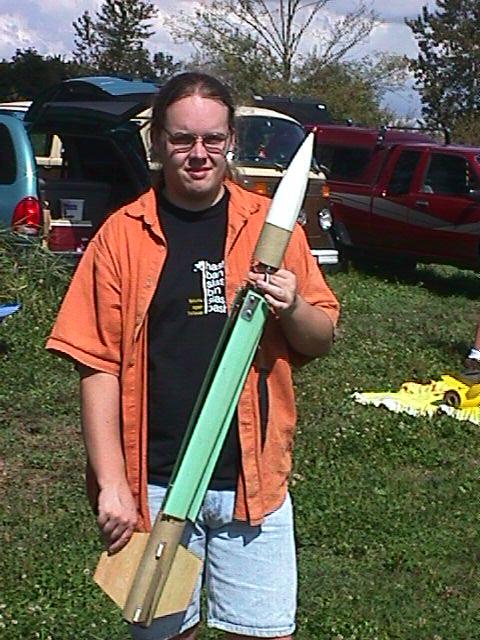
Except it didn't work. It blew itself in half on the first flight. I redesigned that, and on the second flight it remained whole... but the blades only partially deployed. The springs pulled them slightly out, they immediately spun up very fast, the drag visible slowed the rocket some, and that was it. It nose-dived with the blades spinning madly at about 15 degree deployment. The wind resistance overcame the springs, and once they spun up the gyroscopic forces kept it from tipping over into the preferred, high-drag configuration. I could only think of some very complicated solutions, involving motorized deployment, and dropped it. A couple months later I dropped out of high power rocketry entirely.
But tonight, bored, I think I came up with a pretty good solution. It will still require an altimeter/accelerometer (standard equipment), but just to fire a single explosive bolt as if deploying a main 'chute. (That might sound crazy, but I already have a reusable 'explosive bolt'. They're not unheard of in the hobby.) Add another spun section, really just a disk. Fix it to the unspun section using the explosive bolt for release. (Implementation: a toggle through both that has a spring pulling on it, and the explosive bolt holding the strain.) On the upper spun section, the blades would be attached to a nut on a central bolt attached to the lower spun section. On deployment, the blades spin up, turning the upper spun section. This advanced the nut along the bolt, pulling the blades up. This continues until it hits a stop. Now both spun sections and fixed to the unspun section and the blades aren't moving. Without gyroscopic forces resisting rotation, the rocket tumbles, with plenty of time to fall into the high-drag state of blades up/tail down. At 1000 feet, or whatever the altimeter device is set to, the explosive bolt is fired. The toggle is pulled out, freeing the lower spun section from the unspun tail section. Both spun sections, still fixed together, spin up and the rocket autorotates in for a nice, smooth landing.
Almost makes me want to take up rocketry again.