![[personal profile]](https://www.dreamwidth.org/img/silk/identity/user.png)
So, I'm working on refurbishing this rusty old leg vise. And I came across a lot of references to electrolytic rust removal. It looked easy, effective, and really cool. So of course I had to try it.
Rust is ferric oxide, Fe2O3. It is bulkier than the base metal, so it puffs up, exposing more metal to rust away in turn. Nasty stuff. However, there is also ferrous oxide, FeO. This is a black material also known as hammerscale. It can form very quickly on hot metal, and while not as structural as pure iron or steel, it serves as a decent protective layer. (Gun bluing is the controlled creation of a layer of ferrous oxide.)
The idea is pretty simple. Put the work piece in an electrolytic solution (water and baking soda). Run current from a sacrificial anode to the work piece as the cathode. The ferric oxide is converted to ferrous oxide. This doesn't restore lost metal -- what is gone is gone. But the loose rust is removed, and what rust is still firmly attached stays. Unrusted metal isn't touched at all. Brilliant!

I tested with this little wedge piece from the mounting assembly. Easy to submerge in the electrolyte, and easy to fabricate a replacement should it all go horribly wrong.

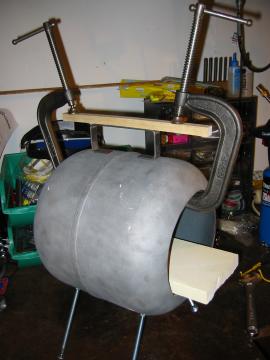
It was done in a small plastic container. The sacrificial anode is a piece of 16 gage sheet metal I bent into a rough circle. (Not easy to do -- luckily I happen to have an anvil and some big hammers.) I used my 12V benchtop power supply. A car battery, battery charger, or computer power supply would all work just fine. The piece of wood is used to suspend the work piece in the solution -- the burn mark was already there, thanks to a crazy clamping system used when I welded the handle on the forge.

I flipped the switch and got bubbles instantly. These should be pure oxygen (2Fe2O3 -> 4FeO + O2, right?), but I didn't light a match to test this theory. It isn't impossible that I'm electrolyzing the water as well, in which case there would be a fair amount of hydrogen around as well.

As it went on the water got dirtier...

...and dirtier. Nasty combination of partially dissolved rust and hammerscale bits, slightly frothy.
After about 40 minutes I had to run for the bus, so it didn't completely finish. Doesn't matter for this piece.

The anode is, indeed, sacrificial. Be careful you get the polarity right, or this will happen to your workpiece! I have read reports of people successfully using stainless steel anodes, but I'm not sure I'll be doing this enough to bother.

And that's what you get, after a bit of scrubbing. Wonderful! Better living through chemistry, aw yeah.

Rust is ferric oxide, Fe2O3. It is bulkier than the base metal, so it puffs up, exposing more metal to rust away in turn. Nasty stuff. However, there is also ferrous oxide, FeO. This is a black material also known as hammerscale. It can form very quickly on hot metal, and while not as structural as pure iron or steel, it serves as a decent protective layer. (Gun bluing is the controlled creation of a layer of ferrous oxide.)
The idea is pretty simple. Put the work piece in an electrolytic solution (water and baking soda). Run current from a sacrificial anode to the work piece as the cathode. The ferric oxide is converted to ferrous oxide. This doesn't restore lost metal -- what is gone is gone. But the loose rust is removed, and what rust is still firmly attached stays. Unrusted metal isn't touched at all. Brilliant!
I tested with this little wedge piece from the mounting assembly. Easy to submerge in the electrolyte, and easy to fabricate a replacement should it all go horribly wrong.
It was done in a small plastic container. The sacrificial anode is a piece of 16 gage sheet metal I bent into a rough circle. (Not easy to do -- luckily I happen to have an anvil and some big hammers.) I used my 12V benchtop power supply. A car battery, battery charger, or computer power supply would all work just fine. The piece of wood is used to suspend the work piece in the solution -- the burn mark was already there, thanks to a crazy clamping system used when I welded the handle on the forge.
I flipped the switch and got bubbles instantly. These should be pure oxygen (2Fe2O3 -> 4FeO + O2, right?), but I didn't light a match to test this theory. It isn't impossible that I'm electrolyzing the water as well, in which case there would be a fair amount of hydrogen around as well.
As it went on the water got dirtier...
...and dirtier. Nasty combination of partially dissolved rust and hammerscale bits, slightly frothy.
After about 40 minutes I had to run for the bus, so it didn't completely finish. Doesn't matter for this piece.
The anode is, indeed, sacrificial. Be careful you get the polarity right, or this will happen to your workpiece! I have read reports of people successfully using stainless steel anodes, but I'm not sure I'll be doing this enough to bother.
And that's what you get, after a bit of scrubbing. Wonderful! Better living through chemistry, aw yeah.